
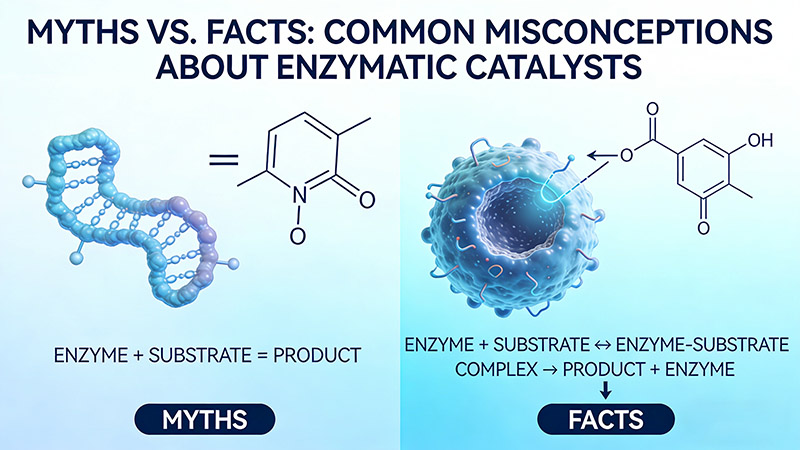
Enzymatic catalysts are the unsung heroes of modern industrial biotechnology. From food processing and biofuel production to pharmaceuticals and sustainable manufacturing, enzymes drive reactions with remarkable speed and precision. Yet, despite their widespread use, many misconceptions persist about how they work, where they function, and whether they are truly viable for large-scale applications.
In this article, we separate myth from fact — helping you see enzymatic catalysts for what they really are: powerful, versatile, and increasingly indispensable tools for green chemistry and efficient production.
Fact: Enzymes function perfectly outside living organisms — often even better.
It’s a common belief that enzymes are so “biological” that they lose their power once removed from a cell. In reality, isolated enzymes have been used for over a century in industrial processes. As long as their basic requirements (such as appropriate pH, temperature, and water activity) are met, they remain highly active. In fact, modern enzyme engineering has produced cell-free systems that outperform whole-cell fermentation in many cases — offering higher yields, fewer by-products, and easier downstream processing.
Fact: While some enzymes are delicate, many are remarkably robust — and stability can be engineered.
The image of enzymes as “finicky proteins that denature at the slightest disturbance” is outdated. Today, enzymes are available that function at temperatures above 80°C, in concentrated salt solutions, and across a wide pH range. Furthermore, techniques like immobilization (binding enzymes to solid supports) greatly enhance thermal, pH, and operational stability. Protein engineering and directed evolution have produced enzyme variants that withstand harsh industrial conditions — without losing catalytic power.
Fact: Enzyme costs have dropped dramatically, and reusability makes them highly cost-effective.
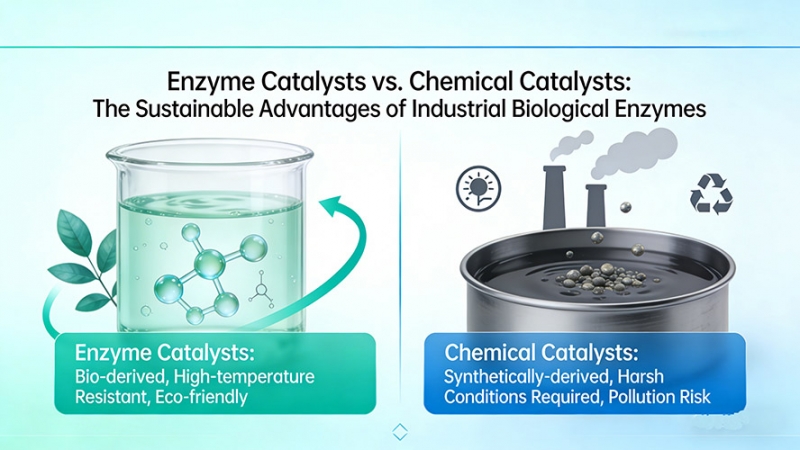
Decades ago, isolating and purifying enzymes was laborious and costly. But advances in microbial fermentation, recombinant DNA technology, and downstream processing have slashed production costs. Many industrial enzymes now cost only a few dollars per kilogram. Moreover, immobilization allows enzymes to be recovered and reused dozens or even hundreds of times. When total process economics are considered — including higher reaction specificity, milder operating conditions (reducing energy costs), and fewer side products — enzymes often beat traditional chemical catalysts.
Fact: Enzymes are among the fastest catalysts known.
Some chemical catalysts work in hours or minutes — but many enzymes work in milliseconds. For example, catalase can decompose hydrogen peroxide nearly 10 million times faster than an inorganic catalyst. The turnover numbers (kcat) of many enzymes exceed thousands of reactions per second per active site. The misconception likely arises from unfamiliarity with enzyme kinetics. True, some enzymes are slower, but on a rate-per-active-site basis, they routinely outperform synthetic catalysts. When productivity (space-time yield) and selectivity are factored in, enzymes are often the speed champions of industrial catalysis.
Fact: Extremophilic enzymes thrive in harsh conditions — and they are commercially available.
The classic textbook enzyme works best at body temperature and neutral pH. However, nature is full of extremophiles — organisms living in hot springs, deep-sea vents, acidic mine drainage, and Antarctic ice. Their enzymes (thermophilic, acidophilic, psychrophilic, etc.) are perfectly adapted to extreme conditions. Today, you can buy proteases that work at 90°C, amylases that function at pH 2–3, and lipases that remain active in organic solvents. For conditions beyond natural extremes, protein engineering can push boundaries even further.
Fact: Specificity is a strength — and enzymes can be tuned to broaden or alter it.
It is true that many enzymes exhibit exquisite specificity (e.g., a single stereoisomer). Far from being a limitation, this eliminates unwanted by-products, simplifies purification, and reduces waste. When a broader substrate range is desired, directed evolution and rational design can reshape enzyme active sites. Today’s enzyme engineers routinely create “promiscuous” enzymes that accept unnatural substrates — enabling novel chemical synthesis routes that were previously impossible.
Fact: Many enzymes function surprisingly well — and sometimes better — in non-aqueous media.
Water is not always mandatory. Since the landmark discovery in the 1980s that enzymes can be active in organic solvents, biocatalysis in non-aqueous systems has become a standard tool. In nearly anhydrous organic solvents, enzymes can catalyze reactions that are impossible in water (e.g., ester synthesis, peptide bond formation). Moreover, organic solvents often increase thermal stability and shift equilibrium toward desired products. The key is to choose the right enzyme and maintain a minimal water layer (“essential water”) around it.
The field of enzymatic catalysis has matured far beyond the textbook stereotypes. With modern tools — metagenomics, high-throughput screening, computational design, and immobilization technology — today’s industrial enzymes are stable, cost-effective, fast, and adaptable to extreme conditions.
At Witrust Bio, we harness the true potential of enzymatic catalysts to solve real-world challenges: greener manufacturing, lower energy consumption, and higher product purity. Whether you are exploring biocatalysis for the first time or looking to replace an existing chemical process, we invite you to challenge the myths — and discover what enzymes can truly do.
Want to learn more? Contact Witrust team or explore our portfolio of industrial enzymes and custom biocatalyst development services.
Let science drive your success — one reaction at a time.
© Copyright - | All Right Reserved. Designed By witrustbio.com
 Send Email
 Philip Wu
 Frank68001