
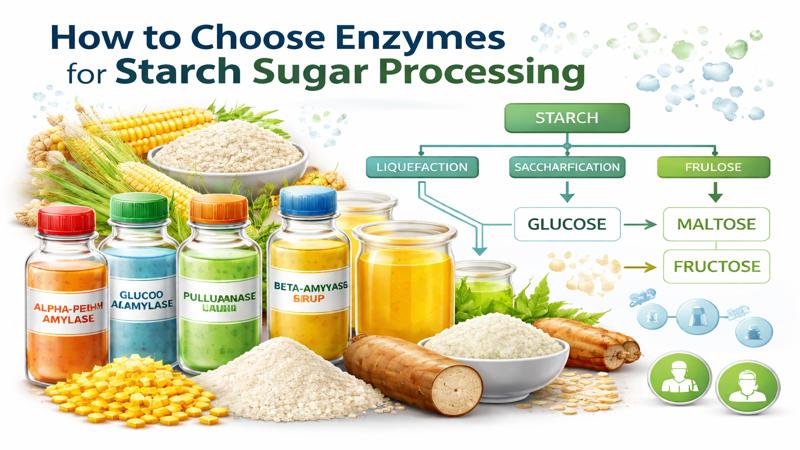
Starch sugar, as a versatile ingredient widely used in food, beverage, pharmaceutical, and biofuel industries, is produced by hydrolyzing starch—naturally present in corn, wheat, cassava, and other grains—into simple sugars like glucose, maltose, and fructose. The key to efficient, high-quality, and cost-effective starch sugar production lies in selecting the right enzymes. Unlike traditional acid hydrolysis, enzymatic hydrolysis offers mild reaction conditions, higher conversion rates, and better product quality, making enzyme selection a critical decision that directly impacts production efficiency, product specifications, and operational costs. This guide provides a practical framework for choosing the right enzymes for starch sugar processing, covering key enzyme types, selection criteria, and best practices for optimal results.
Starch is a polysaccharide composed of two glucose polymers: amylose (linear chains linked by α-1,4 glycosidic bonds) and amylopectin (branched chains containing both α-1,4 and α-1,6 bonds). Because yeast and other fermenting microorganisms cannot directly utilize starch, it must first be enzymatically hydrolyzed into smaller sugars such as dextrins, maltose, and glucose.
Industrial starch conversion typically occurs in two enzymatic stages:
Liquefaction: Partial breakdown of gelatinized starch, rapid viscosity reduction, and conversion of long starch chains into soluble dextrins.
Saccharification: Conversion of dextrins into fermentable sugars—primarily glucose for ethanol and glucose syrup applications.
Different enzymes operate at different stages of this process and perform fundamentally different functions. Using the wrong enzyme—or using the right enzyme at the wrong stage—can result in lower sugar yield, incomplete starch conversion, higher fermentation residue, and increased production costs.
The commercial processing of starch to mono- and oligosaccharides depends on three major enzymes—glucoamylase, alpha-amylase, and glucose isomerase—along with several supporting enzymes such as pullulanase and beta-amylase for specialized applications.
Alpha-amylase is used in the liquefaction step, producing soluble dextrins from gelatinized starch. This enzyme randomly cleaves internal α-1,4 bonds in starch molecules, rapidly reducing viscosity and enabling efficient downstream processing.
Two main types are commonly used in industrial starch processing:
Bacterial (High-Temperature) α-Amylase:
Produced from bacterial sources such as Bacillus licheniformis
Functions at high temperatures (typically 90–110°C)
Essential for the initial liquefaction step where starch is gelatinized at high temperatures
Market projections show this segment reaching USD 3.1 billion by 2034, growing at 6.2% CAGR
Fungal α-Amylase:
Produced from fungal sources such as Aspergillus oryzae
Functions at moderate temperatures (typically 50–65°C)
Used in specialized applications where lower-temperature liquefaction is required
Produces a different dextrin profile compared to bacterial amylase
Selection tip: For standard high-temperature starch liquefaction (108–110°C jet cooking), select thermostable bacterial α-amylase. For specialty syrup production requiring specific saccharide profiles, fungal α-amylase may offer advantages.
Glucoamylase further hydrolyzes dextrins to glucose in the saccharification step. Unlike alpha-amylase, glucoamylase is an exo-acting enzyme that cleaves glucose units sequentially from the non-reducing ends of starch chains and can also hydrolyze α-1,6 branch points (though at a slower rate).
Key considerations when selecting glucoamylase:
pH optimum: Most glucoamylases work best around pH 4.0–4.5 and must remain stable under acidic conditions for extended saccharification times (typically 48–72 hours)
Temperature range: Usually operates at 55–65°C
Glucose yield: High-quality glucoamylase can achieve dextrose equivalent (DE) values of 95–98% in optimized systems
Reversion control: Excessive glucoamylase can promote reversion reactions where glucose recombines into undesirable disaccharides
Pullulanase is an important debranching enzyme widely utilized to hydrolyze α-1,6 glucosidic linkages in starch, amylopectin, pullulan, and related oligosaccharides, enabling a complete and efficient conversion of branched polysaccharides into fermentable sugars during saccharification.
In starch sugar production, pullulanase is used to:
Increase final glucose concentration with reduced amount of glucoamylase
Prevent the reversion reaction that involves resynthesis of saccharides from glucose molecules
Improve overall conversion efficiency by breaking down branch points that glucoamylase hydrolyzes slowly
Currently, the industry standard dual-enzyme method for starch sugar production often results in low target product yield and high by-product ratios; therefore, debranching enzymes are commonly added to assist saccharification.
Selection tip: Adding pullulanase during saccharification can reduce glucoamylase usage by 20–30% while maintaining or improving glucose yield, offering significant cost savings.
β-Amylase is used in the production of high-maltose syrup. This exo-acting enzyme cleaves maltose units from the non-reducing ends of starch chains, producing syrups with high maltose content (typically 50–80% maltose).
When selecting β-amylase for maltose syrup production, the enzyme must have high specificity for α-1,4 glycosidic bonds to avoid excessive hydrolysis that produces too much glucose, which would affect product specifications.
Glucose isomerase catalyzes the reversible isomerization of glucose to fructose, enabling the production of high-fructose corn syrup (HFCS) and related products. Commercial glucose isomerase is typically used in immobilized form for continuous processing, as it facilitates separation from the reaction system and allows for reuse.
Selecting the right enzyme for starch sugar processing requires a systematic evaluation across multiple dimensions. The following framework organizes the key considerations into five essential categories.
Different starch sugar products require different enzyme combinations:
| Target Product | Primary Enzymes Required | Typical DE Range |
|---|---|---|
| Maltodextrin | α-Amylase only (partial hydrolysis) | < 20 |
| Glucose Syrup | α-Amylase + Glucoamylase | 40–98 |
| High-Maltose Syrup | α-Amylase + β-Amylase + Pullulanase | 40–60 |
| High-Fructose Syrup | α-Amylase + Glucoamylase + Glucose Isomerase | 90–95 (before isomerization) |
| Crystalline Dextrose | α-Amylase + Glucoamylase + Pullulanase | > 95 |
Enzyme selection must align closely with your production process conditions:
Continuous vs. Batch Production:
Continuous production lines: Immobilized enzyme preparations are suitable as they can be easily separated from the reaction system and reused. Immobilized glucose isomerase is widely applied in continuous high-fructose syrup production.
Batch production: Liquid enzyme preparations offer greater flexibility, allowing adjustments based on each batch of raw materials and production requirements.
Temperature and pH Compatibility:
For high-temperature liquefaction (108–110°C jet cooking), select thermostable α-amylase that maintains high enzyme activity after hours of exposure above 100°C.
For saccharification, ensure glucoamylase functions stably in acidic environments (around pH 4.0).
Optimized process parameters identified in research include: jet cooking temperature of 108–110°C, liquefaction pH 5.4–5.8, high-temperature holding time of 5–7 minutes post-jet, total amylase dosage of 0.6 kg/t (added in two portions at 40% and 60%), and appropriate addition of debranching enzyme during saccharification when starch slurry concentration exceeds 16°Bé.
Enzyme activity and stability are critical in starch sugar production where high-temperature and acidic environments prevail:
Thermostability: Thermostable α-amylase must maintain high enzyme activity after hours of exposure to temperatures above 100°C.
pH stability: Glucoamylase should function stably in acidic environments (around pH 4.0).
Storage stability: Consider shelf life and storage requirements (liquid enzymes typically require refrigeration, while granular forms may offer better ambient stability).
Activity units: Standardize comparisons based on activity units per gram or milliliter under defined conditions.
Selection tip: Prioritize enzyme products that have undergone specialized treatment processes to enhance stability under your specific operating conditions.
Different starch sugar products require precise substrate matching:
For maltose syrup production, β-amylase must exhibit high specificity for α-1,4 glycosidic bonds in starch to avoid excessive hydrolysis producing unwanted glucose.-
For glucose syrup, select glucoamylase with strong activity on both α-1,4 and α-1,6 bonds.
For specialty syrups with specific saccharide distributions, enzyme combinations can be tailored to achieve target profiles.
Understanding the enzyme‘s mode of action (endo-acting vs. exo-acting) and catalytic efficiency helps effectively optimize process parameters. Taking glucose isomerase as an example, its isomerization reaction rate directly affects high-fructose syrup production efficiency, requiring manufacturers to test the catalytic efficiency of different enzyme preparations through experimentation and select the most efficient product.
Cost is an important factor in enzyme selection, but requires comprehensive evaluation:
Direct costs: Enzyme price and usage amount
Indirect benefits: Improvements in production efficiency and product quality
Long-term value: Some new enzyme preparations, despite higher prices, can reduce overall usage and increase yield due to their efficiency and stability, thereby lowering comprehensive costs in the long run.
Additionally, enzymes must comply with national food safety standards, with strict control over source, production process, and impurity content to ensure products have no harmful residues and protect consumer health.
Different starch sources (corn, wheat, potato, cassava, etc.) have varying amylose/amylopectin ratios and structural characteristics that affect enzyme performance:
Potato and wheat starches can achieve DE values of 97.04% and 97.27% respectively under optimized conditions-
Maize starch, the most common commercial source, achieves around 95.34% DE
Enzyme combinations may need adjustment based on the specific starch source and its gelatinization properties
Choosing the right enzymes for starch sugar processing is a systematic process that requires understanding enzyme functions, aligning with product goals, and optimizing process conditions. By selecting the appropriate α-amylase, glucoamylase, debranching enzymes, and specialized enzymes, matching them to your raw materials and process parameters, and following practical optimization tips, you can achieve high conversion rates, consistent product quality, and cost-effective production.
At WitrustBio, we offer a full range of high-quality enzymes for starch sugar processing, including high-temperature α-amylase, glucoamylase, pullulanase, and β-Amylase for target products. Our technical team provides customized solutions to help you optimize enzyme selection and process parameters, ensuring your production line operates at peak efficiency. Contact us today to learn how our enzyme solutions can support your starch sugar production goals.
© Copyright - | All Right Reserved. Designed By witrustbio.com
 Send Email
 Philip Wu
 Frank68001