
Enzymes are biological catalysts that play an irreplaceable role in countless industrial processes, from food and beverage production to biopharmaceuticals, textile manufacturing, and environmental engineering. Their activity directly determines the efficiency of catalytic reactions, product quality, and production costs. Accurately measuring enzyme activity is not only the foundation of enzyme research and development but also a key link in industrial quality control and process optimization. This article systematically explains the core principles, mainstream methods, key influencing factors, and practical application guidelines for measuring enzyme activity, providing a comprehensive reference for professionals in related fields.
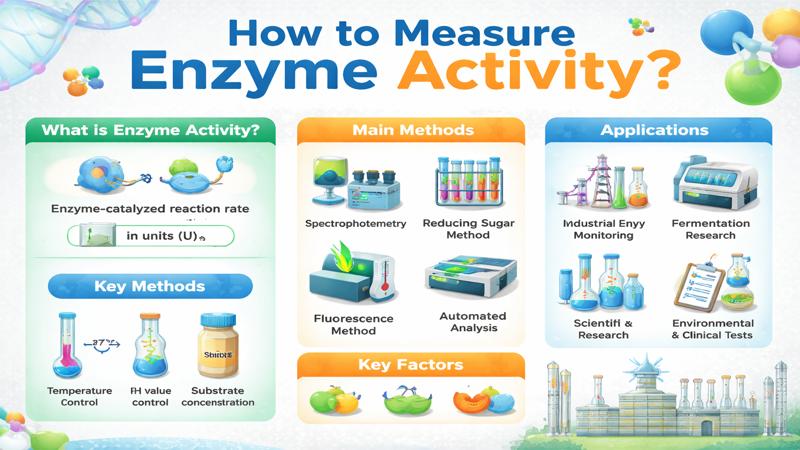
Enzyme activity refers to the ability of an enzyme to catalyze a specific biochemical reaction, which is essentially a measure of the quantity of active enzyme present in a system. It is quantified by the rate of the enzyme-catalyzed reaction—specifically, the amount of substrate converted or product formed per unit time under standardized conditions.
The standard unit of enzyme activity is the katal (kat), defined as 1 mole of substrate converted per second (1 kat = 1 mol·s⁻¹). However, due to its large size, the more practical and widely used unit is the enzyme unit (U), which is 1 micromole of substrate converted per minute (1 U = 1 μmol·min⁻¹), equivalent to 16.67 nanokatals. In specific industries, special units are also used: for example, gelatin digesting units (GDU) for gelatin-digesting enzymes and milk clotting units (MCU) for milk-clotting enzymes, with 1 GDU approximately equal to 1.5 MCU.
In addition to enzyme activity, specific activity is another important indicator, referring to the enzyme activity per milligram of total protein (expressed in μmol·min⁻¹·mg⁻¹). It reflects the purity of the enzyme in a mixture and is constant for a pure enzyme under specific conditions.
The core principle of measuring enzyme activity is based on the specificity and efficiency of enzyme-catalyzed reactions: under controlled conditions (fixed temperature, pH, substrate concentration, etc.), the reaction rate is proportional to the enzyme activity within a certain range. Therefore, by detecting the change in substrate concentration or product yield over time, we can calculate the enzyme activity.
There are two main measurement strategies: the endpoint method (fixed-time method) and the kinetic method (continuous method). The endpoint method measures the amount of substrate converted or product formed after a fixed reaction time, then calculates the average reaction rate. The kinetic method continuously monitors the dynamic changes of the reaction system in real time, capturing the initial reaction rate (the fastest and most stable stage of the reaction), which is more accurate and widely used in scientific research and industrial detection.
Regardless of the method, strict quality control is required: each test must set blank controls to eliminate background interference from substrates or reagents, prepare standard curves for quantitative calibration, and conduct 2-3 parallel experiments to ensure the reproducibility of results (usually requiring a relative standard deviation RSD < 5-10%).
With the development of biotechnology, a variety of enzyme activity measurement methods have been developed, each with its own characteristics and applicable scenarios. The following are the most commonly used methods in industry and research:
Spectrophotometry is the most widely used method for enzyme activity measurement, thanks to its simplicity, rapidity, high sensitivity, and low cost. It leverages the difference in light absorption properties between substrates and products at specific wavelengths—when the enzyme catalyzes the reaction, the concentration of substrates decreases or products increases, leading to a change in the absorbance of the reaction system. By measuring the absorbance change over time, the reaction rate and enzyme activity can be calculated.
For example, in the measurement of glucose oxidase activity, glucose oxidase catalyzes the oxidation of glucose to produce hydrogen peroxide, which reacts with Amplex® Red reagent under the action of horseradish peroxidase (HRP) to form a colored product. This product has a maximum absorption at 560 nm, and the enzyme activity can be quantified by detecting the absorbance change at this wavelength using a UV-Vis spectrophotometer (such as Thermo Scientific™ Evolution 350). This method is widely used in the detection of oxidoreductases and is suitable for routine industrial quality control.
The reducing sugar method is a classic method for measuring the activity of hydrolases (such as cellulase, amylase, and protease). Hydrolases catalyze the hydrolysis of macromolecular substrates (such as cellulose, starch, and proteins) into small-molecule reducing sugars (such as glucose, maltose, and amino acids). Specific reagents (such as DNS reagent, Nelson-Somogyi reagent, or BCA reagent) react with reducing sugars to form colored substances, and the absorbance of the reaction system is measured to quantify the amount of reducing sugars, thereby calculating enzyme activity.
A typical application is the measurement of cellulase activity: cellulase hydrolyzes cellulose into reducing sugars, and the DNS reagent reacts with these reducing sugars under high temperature to form a brown-red complex. The absorbance at 540 nm is proportional to the amount of reducing sugars, and the enzyme activity is calculated using a glucose standard curve. The filter paper activity (FPA) method, which reflects the comprehensive hydrolysis ability of cellulase on natural crystalline cellulose, and the CMCase method, which is used to measure endoglucanase activity, both belong to the reducing sugar method category.
The fluorescence method is a high-sensitivity measurement method, suitable for detecting trace enzyme activity or in complex systems (such as biological samples). It uses fluorescent substrates or products—when the enzyme catalyzes the reaction, the fluorescent properties (fluorescence intensity, emission wavelength) of the system change significantly. By detecting the change in fluorescence intensity over time, the enzyme activity can be accurately measured.
Amplex Red and Amplex UltraRed reagents are commonly used fluorescent substrates, which have high stability and sensitivity, and their fluorescence emission wavelength is outside the range of spontaneous fluorescence of compounds, reducing background interference. This method is widely used in drug discovery, clinical diagnostics, and single-molecule enzyme activity detection (such as the eSimoa method, which can detect enzyme activity at the single-cell level).
In addition to the above methods, there are many industry-specific measurement methods:
Viscosity Reduction Method: Suitable for measuring endoglucanase activity. Endoglucanase randomly cuts the β-1,4-glycosidic bonds in cellulose molecules, reducing the polymerization degree and viscosity of the cellulose solution. The enzyme activity is evaluated by measuring the viscosity change of the reaction system using a rotational viscometer.
Titration Method: Used for enzymes that catalyze acid-base reactions (such as lipase). The enzyme catalyzes the hydrolysis of substrates to produce acids, and the amount of acid produced is titrated with a standard alkali solution. The enzyme activity is calculated according to the titration volume and reaction time.
Automated Analysis Method: With the development of industrial automation, fully automated enzyme analyzers (such as BMG LABTECH microplate readers and Gallery Enzyme Master enzyme analyzers) have been widely used. These instruments can realize high-throughput detection, automatic data collection and analysis, and improve the efficiency and accuracy of measurement, which is suitable for large-scale industrial production quality control.
Enzyme activity is highly sensitive to environmental conditions, and any deviation from the standard conditions will affect the accuracy of measurement results. Therefore, the following key factors must be strictly controlled during the measurement process:
Temperature: Each enzyme has an optimal temperature. Within the optimal temperature range, the enzyme activity increases with increasing temperature; exceeding the optimal temperature will cause the enzyme to denature and lose activity. Generally, the measurement is carried out at a constant temperature (such as 37°C for human enzymes, 50-60°C for industrial enzymes) using a water bath or thermostat.
pH Value: The optimal pH of the enzyme determines the charge state of the enzyme active site and substrate, affecting the binding efficiency between the enzyme and the substrate. A buffer solution (such as phosphate buffer, Tris-HCl buffer) is used to maintain the pH stability of the reaction system.
Substrate Concentration: To ensure that the enzyme is fully saturated, the substrate concentration should be within the range where the reaction rate no longer increases with the increase of substrate concentration (saturating concentration). Too low a substrate concentration will limit the reaction rate, while too high a substrate concentration may cause substrate inhibition.
Enzyme Concentration: Within a certain range, the reaction rate is proportional to the enzyme concentration. The enzyme concentration should be controlled to ensure that the reaction rate is in the linear range of detection, avoiding excessive or insufficient enzyme concentration affecting the measurement results.
Other Factors: Coenzymes, activators, or inhibitors in the reaction system will affect enzyme activity. For example, some enzymes require specific coenzymes to exert their activity, and metal ions (such as Mg²⁺) may activate enzyme activity, while some chemical substances may inhibit enzyme activity. These factors should be considered and controlled according to the characteristics of the enzyme being measured.
Accurate measurement of enzyme activity is crucial for both scientific research and industrial production, with wide-ranging application scenarios:
Enzyme Preparation Quality Control: In the production of industrial enzymes (such as protease, amylase, and cellulase), enzyme activity measurement is used to calibrate the product potency, ensure product consistency, and meet industry standards and customer requirements.
Fermentation Process Monitoring: In bio-manufacturing processes (such as biofuel, bio-pharmaceutical, and wine production), real-time measurement of key enzyme activity (such as ethanol dehydrogenase) helps optimize fermentation conditions, judge fermentation endpoints, and improve product yield and quality.
Scientific Research and Development: In enzyme engineering, synthetic biology, and drug discovery, enzyme activity measurement is used to evaluate the catalytic efficiency of modified enzymes, screen high-activity enzyme strains, and study enzyme reaction mechanisms and inhibition effects.
Environmental and Clinical Detection: In environmental testing, enzyme activity measurement is used to evaluate the degradation ability of environmental microorganisms on pollutants; in clinical diagnostics, the activity of specific enzymes (such as alanine aminotransferase, lactate dehydrogenase) in body fluids is used as an indicator of disease diagnosis.
Measuring enzyme activity is a precise and systematic task that requires a clear understanding of enzyme characteristics, mastery of core principles, and strict control of experimental conditions. Spectrophotometry, reducing sugar method, fluorescence method, and automated analysis method are the most mainstream measurement technologies, each suitable for different enzyme types and application scenarios. With the continuous development of biotechnology, enzyme activity measurement methods are moving towards higher sensitivity, higher throughput, and more automation, providing stronger technical support for the innovation and development of industries such as biomanufacturing, food processing, and pharmaceutical research.
For enterprises engaged in enzyme-related fields, establishing a standardized enzyme activity measurement system is not only an important guarantee for product quality but also a key driver for improving production efficiency and core competitiveness. By selecting appropriate measurement methods, strictly controlling key factors, and applying advanced detection equipment, enterprises can achieve accurate and efficient enzyme activity measurement, laying a solid foundation for the sustainable development of the industry.
WitrustBio operates our own professional biological laboratory and microbiological testing laboratory, offering services including strain screening, enzyme activity testing, and microbial detection. We have strong R&D expert team support and outstanding technical capabilities.
© Copyright - | All Right Reserved. Designed By witrustbio.com
 Send Email
 Philip Wu
 Frank68001